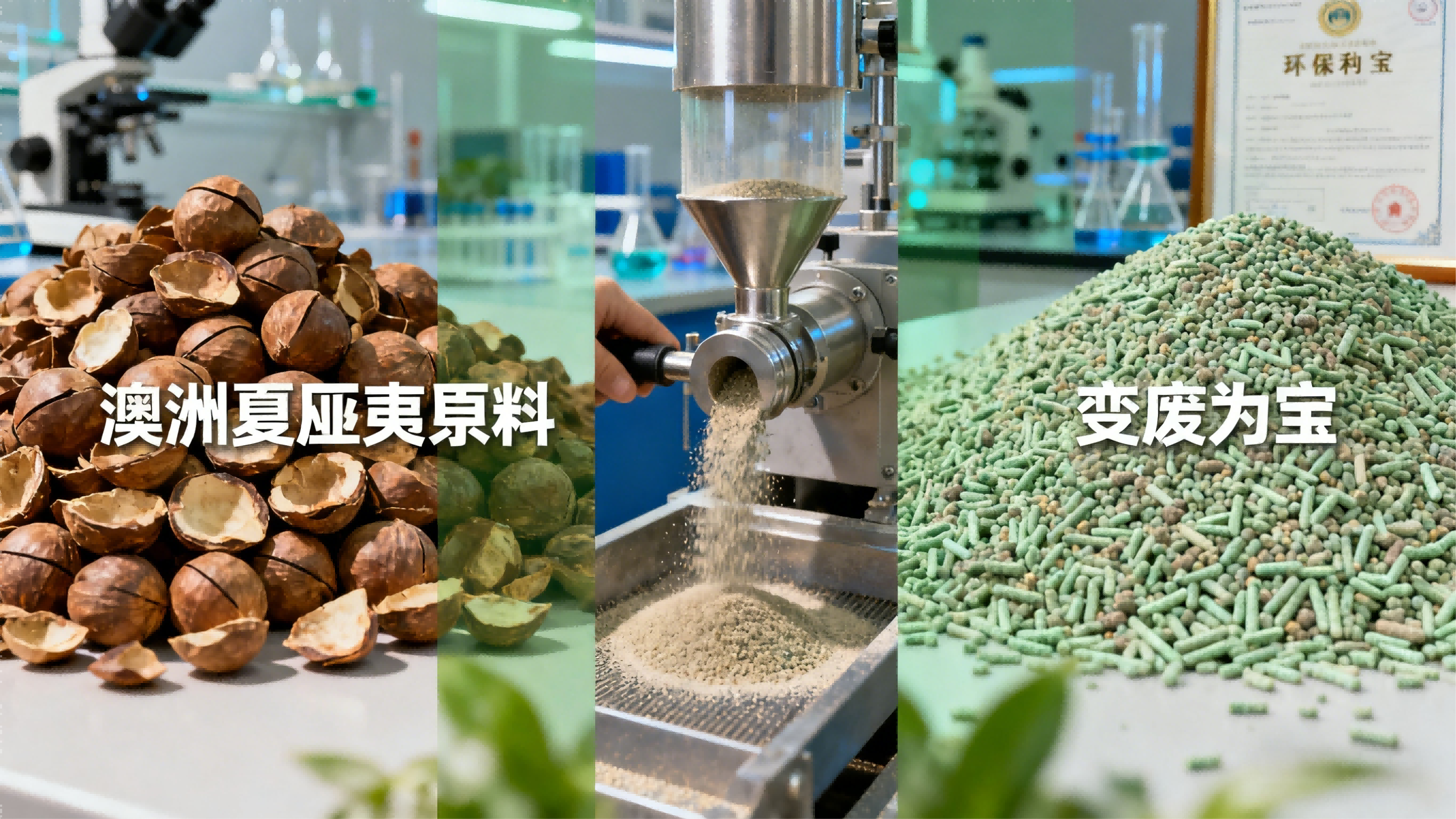
In a groundbreaking development for the pet care industry, a new method of producing cat litter using macadamia nut shells has been granted an invention patent, signalling a major step forward in sustainable resource use and eco-friendly product design. The technology, developed by Jiangcheng Jinao Biotechnology Co., Ltd., repurposes agricultural by-products into high-performance cat litter, achieving both economic and environmental benefits.
1. The Challenge: Limitations of Conventional Cat Litters
As pet ownership grows across Australia, so does demand for sustainable and effective cat litter. Common options such as bentonite clay, silica crystals, and tofu-based litters often come with drawbacks—excessive dust, poor odour control, high production costs, or susceptibility to mould. Many of these also rely heavily on food crops, raising concerns about resource sustainability.
In response, researchers turned to an abundant local resource: macadamia nut shells. Australia is one of the world’s largest producers of macadamias, with thousands of tonnes of shells discarded annually, often ending up in landfill or being burned. Finding value in this waste stream became the focus of the project.
2. The Innovation: Natural Formulation and Advanced Processing
The litter is composed of macadamia shell powder, corn starch, pea residue, calcium carbonate, and a plant-based binder. Macadamia shell powder makes up 20–50% of the content, while pea residue accounts for 30–65%, significantly reducing the use of food-based ingredients.
The production process involves washing, drying, grinding, mixing, compressing, pelletising, sieving, and drying. Macadamia shells are dried at 120–150°C to reduce moisture content below 8%, then milled and sieved for consistency. Pea residue is wet-milled to enhance water absorption and clumping ability. The binder used is derived from natural plant sources and contains odour-neutralising and antibacterial agents.
3. Performance Benefits: Superior Clumping, Odour Control & Sustainability
Testing shows the macadamia-based litter excels in absorbency, clumping strength, odour elimination, and antibacterial performance. Calcium carbonate boosts liquid absorption, while natural microbial and botanical agents break down ammonia and sulphur compounds. The porous structure of the shell powder further enhances adsorption. The product is also flushable and biodegradable, aligning with modern waste disposal preferences.
4. Environmental & Economic Impact: A Win for Circular Economy
This approach not only addresses shell waste but sets a precedent for other agricultural by-products. Each tonne of litter produced saves approximately 0.5 tonnes of food-grade materials and utilises 0.3–0.5 tonnes of macadamia shells.
With lower raw material costs, the litter is expected to be competitively priced. Pilot production is underway, with full market release anticipated in the coming year.
5. Industry Outlook: The Rise of Green Pet Products
As Australian consumers increasingly seek planet-friendly pet products, this innovation taps into a growing market for sustainable, non-toxic, and effective alternatives. Similar litters made from coconut husk, coffee grounds, or barley straw may soon follow.
A Word from the Experts
“Using macadamia shells—a material often treated as waste—to create a high-value product like cat litter is exactly the kind of innovation Australia’s circular economy needs,” said Dr. Emily Watson, a sustainability researcher based in Melbourne. “It reduces pressure on landfills and agricultural resources while meeting consumer demand for greener pet care.”
In Summary
From orchard waste to purr-friendly litter—this technology showcases how smart design can turn environmental challenges into opportunities. As Australia moves toward net-zero targets, such homegrown innovations are set to play an increasingly important role.
This publication will continue to track the commercial rollout and consumer reception of this Australian-born sustainable solution.